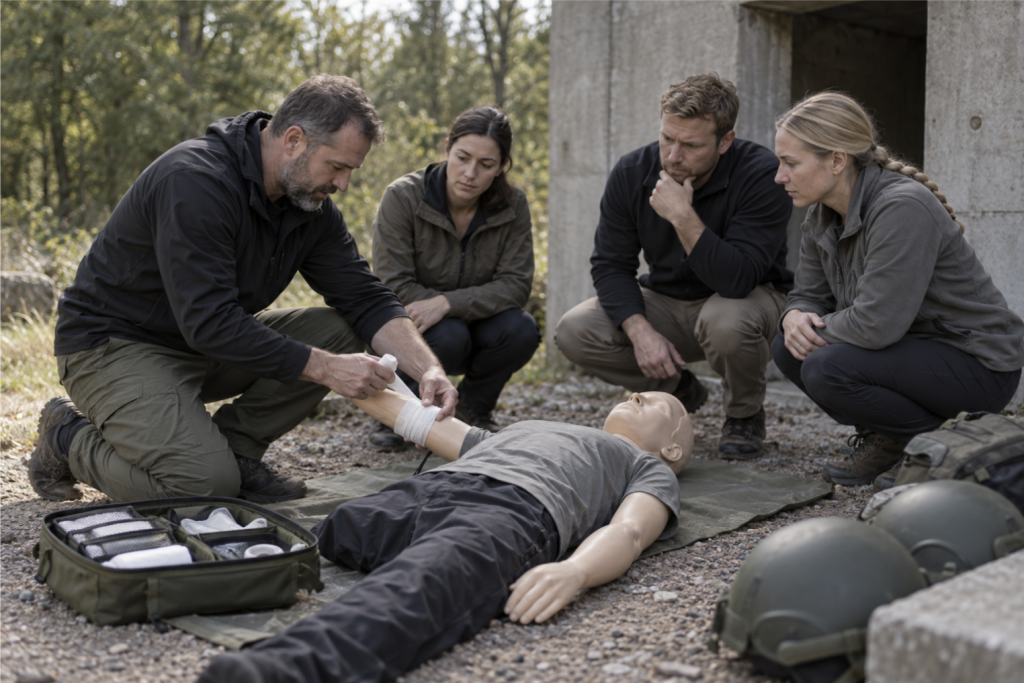
A newsroom can brief a reporter on checkpoint procedure in a single conversation, and most of them do. What the briefing cannot supply is the behaviour of someone who has already stood at a checkpoint while an armed teenager took an interest in the vehicle. The distance between knowing and doing is the entire argument for hostile environment awareness training, and it is why providers of heat training hostile environment preparation spend far more of the week outdoors than in a classroom.
Almost nobody who signs up is a soldier.
A typical intake mixes reporters, camera operators, aid coordinators, fixers, researchers and corporate staff heading somewhere their employer’s duty of care has suddenly acquired teeth. They arrive with baselines that have nothing in common. One participant has covered protests for years and has never opened a trauma kit. Another has solid clinical first aid and no instinct for the moment a crowd stops being a crowd. A course that addresses the room as one audience will bore half of it and lose the rest. The better ones work that out on the first morning and change what they push each person on.
What heat training hostile environment courses teach first
The order of the syllabus tells you what a provider believes. Ballistics demonstrations and staged ambushes photograph well, so weaker courses put them at the front. The stronger ones open with unglamorous material, because avoidance is the only intervention that works every time, and every other skill on the timetable is a consequence of avoidance having failed.
Risk assessment leads, and it is taught as a habit rather than as a form to complete.
- Route and timing decisions, including the more useful question of what would have to change for a trip to be called off, agreed before anyone is sitting in a vehicle arguing about it.
- Communications discipline. A check-in schedule protects people only if somebody is genuinely waiting for the call and knows what to do when it fails to arrive.
- Situational awareness as a practised skill rather than a mood. Participants learn to register absences, which tend to be the earlier signal: the market that emptied, the children called indoors, the police post left unmanned.
None of this is exciting to sit through, which is exactly why it gets trimmed when a client asks for a shorter programme. Trimming it is a false economy. Most of the incidents that hurt civilian teams are not sophisticated. They are the wrong road, the wrong hour, an unsuitable vehicle, or a check-in that nobody noticed had been missed. The dramatic skills people imagine they are buying only matter once those earlier decisions have gone badly. Teams that get the earlier decisions right rarely need the rest of the syllabus.
How a hostile environment awareness training heat programme builds judgement under pressure
Adrenaline takes things away from you. Fine motor control goes first, peripheral vision narrows, and the capacity to hold a plan in working memory shrinks to whatever has been rehearsed often enough to run without attention. No classroom reproduces that, so scenario work exists to load participants just enough for the effect to appear while instructors stand close by.
The scenario is not the lesson. The debrief is.
A well-run hostile environment awareness training heat exercise ends with people sitting down and reconstructing what they did and why, in sequence, before anyone tells them what they should have done. Participants usually discover they walked past information that was in plain sight, or that one confident voice in the group overrode several uneasy ones. Those are the findings that change behaviour on a real deployment. Being handed the correct answer afterwards changes very little. Providers differ most in how much time they protect for this part of the day, and it is the first thing squeezed when a group is too large.
Realism has a ceiling, and the ceiling is ethical rather than technical. Simulated detention, restraint and abduction can teach genuine things about compliance, pacing and self-management, and they can also damage someone who was not told what was coming. Reputable instructors set out the boundaries in advance, give participants a way to stop, and watch for the person who should not be pushed any further that day.
Inside a hostile environment and awareness training course
Syllabuses vary by provider and by region, but the spine of a hostile environment and awareness training course stays fairly consistent, because the hazards do.
- Trauma care under pressure. Catastrophic bleeding, airway management, and the discipline of working through a casualty in a fixed order while somebody else takes charge of the scene.
- Weapons effects and cover. Not how to use a weapon, but what different rounds do to the materials people instinctively hide behind, most of which conceal rather than protect.
- Checkpoints, vehicle drills and roadblocks, including the unremarkable skill of reversing out of a narrow street while everyone in the car talks at once.
- Recognition of mines and unexploded ordnance, taught with the standing rule that recognition is the entire skill and nothing follows it except stopping, marking and reporting.
- Detention, questioning and abduction survival, approached as behaviour sustained over weeks rather than as escape.
- Digital and information security, since the phone in a journalist’s pocket usually describes their movements more accurately than they could from memory.
Some of these skills decay much faster than others. Trauma care fades within months without practice, and the willingness to start treating someone fades with it. Recognition and avoidance last longer, because they sit closer to ordinary judgement and get used on quiet days as well as bad ones. That difference is the argument for refresher training, and it is also why an assessed course is worth more than an attended one. A participant who was never tested has only a guess about which parts they can perform. Their employer, reading a certificate, has less than that.
Judging hostile environment security training before you book it
Procurement tends to compare price, duration and accreditation, and those are the criteria least likely to predict what a team comes home with. Accreditation establishes a floor, which is not the same as quality. What sits above the floor is the instructors, the group size during scenarios, and how honest the provider is about what a short course cannot do.
Four questions separate providers quickly.
- Who teaches, and what they did before. Military and ambulance backgrounds are common and useful, but ask specifically who has worked alongside civilian teams, because managing a frightened reporter is not managing a soldier.
- How many participants each instructor supervises during scenarios. Realism scales badly, and a large group means most people watch while a few take part.
- What happens to the person who struggles. A provider with no answer for the participant who freezes has not thought seriously about its own audience.
- Whether the provider will ever say no. A company willing to tell a client that a week of hostile environment security training will not make an underprepared team ready for a particular deployment is giving you the clearest quality signal on offer.
None of this makes anybody safe, and a course that implies otherwise should worry you. What good preparation buys is a shorter pause between recognising a situation and doing something sensible about it, plus a team that has already argued about its limits somewhere harmless. That is a smaller claim than the brochures usually make. It is also the one that holds up on the road.










