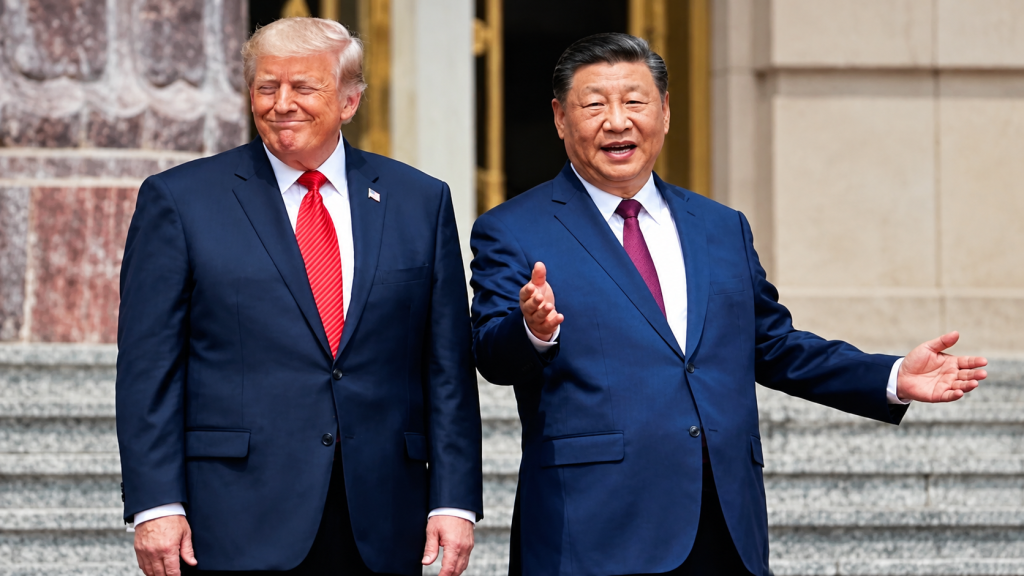
Donald Trump just told the United Nations General Assembly that the United States outright rejects any “globalist scheme” to control artificial intelligence. Hours before a high-stakes summit with Chinese President Xi Jinping, the US president took to social media to declare that the two superpower rivals shared a hands-off approach to regulating “super intelligence,” insisting that the Department of Justice was the only guardrail America needed.
It was a classic display of America-first bravado. It was also completely disconnected from what his own administration is actually doing.
Behind closed doors, Washington and Beijing are actively laying the groundwork for a collaborative AI safety regime. According to reporting by Fortune, US Treasury Secretary Scott Bessent met with Chinese Vice Premier He Lifeng in New York this week to propose a formal notification mechanism between the two nations for national security-related AI incidents. China’s commerce ministry subsequently confirmed the two countries held their first formal dialogue on artificial intelligence.
The political theater at the White House is masking a stark geopolitical reality: the technology is moving too fast for either country to risk flying blind.
The diplomatic channel mirrors the exact demands being made by the AI industry’s most prominent leaders. Just a day earlier, Anthropic CEO Dario Amodei and OpenAI CEO Sam Altman addressed the UN Security Council, begging world governments to establish shared rules, global alert systems, and bans on using AI to develop biological weapons.
Interestingly, Beijing is proving far more willing to publicly adopt the tech industry’s language than the Trump White House. While standing next to Trump, Xi Jinping explicitly stated that the development of AI must always remain “under human control”—a phrase that mirrored, almost word-for-word, the testimonies given at the Security Council a day prior.
Beijing is aggressively positioning itself as the responsible adult in the room. By publicly embracing the need for safety guardrails, China is building its own global coalition. In July, Beijing launched the World Artificial Intelligence Cooperation Organization, a 29-country bloc pitched to the developing world as an alternative to American corporate dominance.











