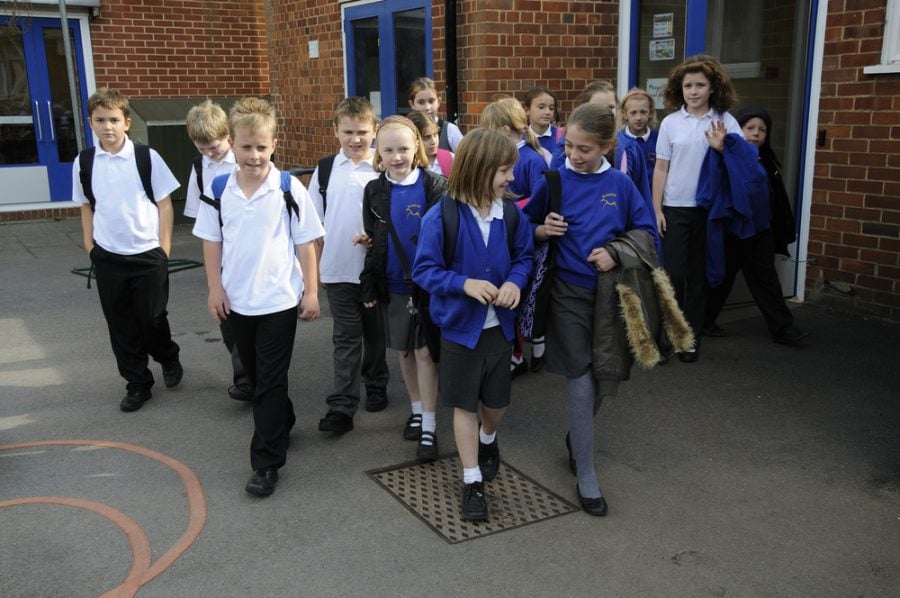
Pity the schoolchildren who are returning to their prison camps this September. Most will now be entering premises entirely surrounded with high security fences, a rapid development that has spread across the country in the past year. In another punishment beating in the national demoralisation campaign, school security is a tragic indicator of a society gone wrong.
Updated on July 12th 2024, the Department for Education’s ‘School and College Security’ has caused a rush of previously pleasant schools being fenced off with ugly metal structures and keypad entry – another win for Bridget Phillipson and Britain’s low trust society. High security in London secondaries has been the case for years, but is a new sadness for quiet market towns and otherwise peaceful Cathedral cities.
The guidance reads:
The boundary is the first line of defence and should be protected with a secure fence or railings such as Weldmesh fencing to BS1722 or expanded metal or railings over 2.0m high.
Gates should be the same height as the fencing, fitted with anti-lift hinges, locking mechanisms that do not aid climbing and secured using an approved locking mechanism.
Planting close to the base of a fence can also be a deterrent but should not exceed 1.0m in height. Tree canopies should fall no lower than 2.0m from the ground to provide clear lines of sight.
I look at the beautiful Georgian building in our town that used to house the old Grammar school and compare it with the newly-security-fenced, largely 1960s secondary and feel utter misery. Gone are the days of nipping into the reception to collect a poorly child or drop off a forgotten violin. Instead, parents wait outside the security fence for a reluctant receptionist – no doubt furious at having to press the button release for the nth time that day – to let them in. The parent/delivery driver/pupil who has had to visit the orthodontist/visiting speaker/supply teacher, becomes just a dab more diminished at being treated like a potential maniac who needs restraining behind a two-metre-high fence.
After teaching an after-school confidence club in a sea-side town last term, I was walked back to reception by a couple of pupils to return my lanyard. The reception was closed so I left my lanyard on the desk and made my own way out. But the fenced exit was locked. Eventually a pupil (who knew the code that only the teachers are supposed to use) let me out. Freedom! Except this school had a double security fence so I was trapped in-between both. Eventually a group of cleaners arrived and I was let out. What does this level of security do to a child’s sense of confidence when used every day? Reassuring, infuriating or frightening? All three?
Not only has school security ramped up in the fence department – but – good news – lockdown drills are now also a feature of school life in Britain 2025! A cheerful 63-page guidance document from April 2025, ‘Protective security and preparedness for education settings‘ advises schools to practice lockdown protocols and encourages schools to have a “Public Access Trauma first aid kit (PAcT) – a first aid kit which supports the treatment of immediate, life-threatening injuries”. Children are forced to imagine a terrorist or gunman shooting up the school. All over Britain last year, secondary school and college children experienced lockdown drills where alarms sounded, doors were bolted and they hid under their desks. They will be doing so again this school year in order to fulfil the advice that “a rolling programme of testing and exercising is recommended to ensure your setting remains as prepared as possible”. Lucky them.
Read More: Why Do Schools Now Resemble Prisons?











