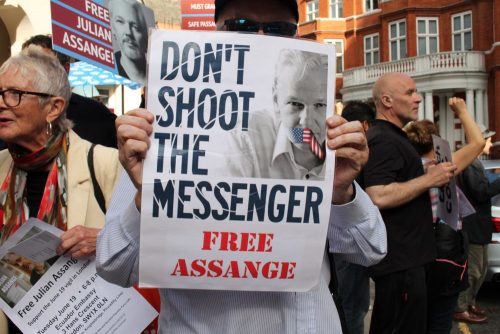
By Neenah Payne
Julian Assange, Australian founder of WikiLeaks, was freed on June 25 after spending over seven years in the Ecuadorian Embassy to avoid extradition to the United States and after being held for over five years in London’s Belmarsh prison (although he had been charged with no crime).
When Assange landed in Australia on June 26 and received a call from the Australian Prime Minister Anthony Albanese, Assange said, “You saved my life!”. Jennifer Robinson, Assange’s Australian legal counsel, worked on his case for 10 years. Jennifer Robinson thanked the PM, the Australian ambassador to Washington, DC. Dr Kevin Rudd, and other Australian officials without whose help Assange would not have been freed.
Julian Assange Is Back Home Now! says “Australian authorities had long lobbied the U.S. to drop its extradition efforts or come up with a diplomatic solution that would allow for Assange’s return home. “We wanted him brought home. Tonight that has happened,” Australian Prime Minister Anthony Albanese told reporters shortly after Assange’s arrival. “This is a culmination of careful, patient, and determined advocacy.”
The Saipan surprise: How delicate talks led to the unlikely end of Julian Assange’s 12-year saga
How Julian Assange Was Freed
Scott Morrison, the Australian Prime Minister of the Liberal coalition from 8/24/18-5/22/22, said on 4/12/19 Julian Assange ‘won’t get any special treatment’.
Anthony Albanese of the Labor party became the Australian Prime Minister on 5/23/22.
Mr. Assange’s legal counsel Jennifer Robinson, who has been on his legal team since 2010, says Prime Minister Albanese has long taken an interest in his case….Within days of the Albanese government’s election in May 2022, the Foreign Minister Penny Wong raised the case with US Secretary of State Antony Blinken while in Tokyo for the Quad summit. The following month the prime minister spoke about Mr. Assange’s case for the first time with President Biden at the NATO conference in Madrid.
Just over a year after he was elected, Mr. Albanese attended the coronation of King Charles. In London he made his strongest comments to that point about the failure to find a diplomatic solution to the matter during an interview with the ABC.
It wasn’t known publicly at the time, but behind the scenes there was movement. The prime minister had given Mr. Assange’s legal team an important steer that things might be shifting in Washington. “The prime minister told me that he believed that a deal could be done in terms of a plea deal,” Ms. Robinson says. “But that negotiation had to happen with us as his legal team, and the US lawyers, so the prosecutors and my US co-counsel Barry Pollack.”
Kevin Rudd took up his position as Australia’s new ambassador in Washington in March last year. One of his first orders of business was to deal with the Assange case. Mr. Rudd was already very familiar with Mr. Assange’s plight. When he was foreign minister back in 2010, WikiLeaks released around 250,000 US diplomatic cables. Thirteen years later he was about to become a key conduit in preventing Mr. Assange from being extradited to the US and tried under the Espionage Act. “[He was] absolutely, crucial. Kevin was very invested in this,” Mr. Pollack says.
After her conversation with the prime minister about a possible plea deal, Ms. Robinson flew to the US to meet with Mr. Rudd. “We briefed Ambassador Rudd about the case and talked about what this was going to take,” she says. “In terms of the role he played in Washington, he effectively played a mediator role. He spoke to the DOJ, he spoke to other US government departments, making very clear that this was a priority of the prime minister and of the government of Australia that this case be resolved.”
Mr. Pollack, who had struggled to get a hearing from the DOJ initially, was suddenly able to enter meaningful talks about his client. “[Rudd] worked very doggedly, with both the Department of Justice and me trying to nudge each party to get to a resolution that was acceptable to both of us,” he says. “When you have a complex negotiation like that, having a third party almost serving as a mediator to try to bring the two sides together is enormously helpful. And Kevin played that role.
Read More: How Julian Assange Was Finally Freed











