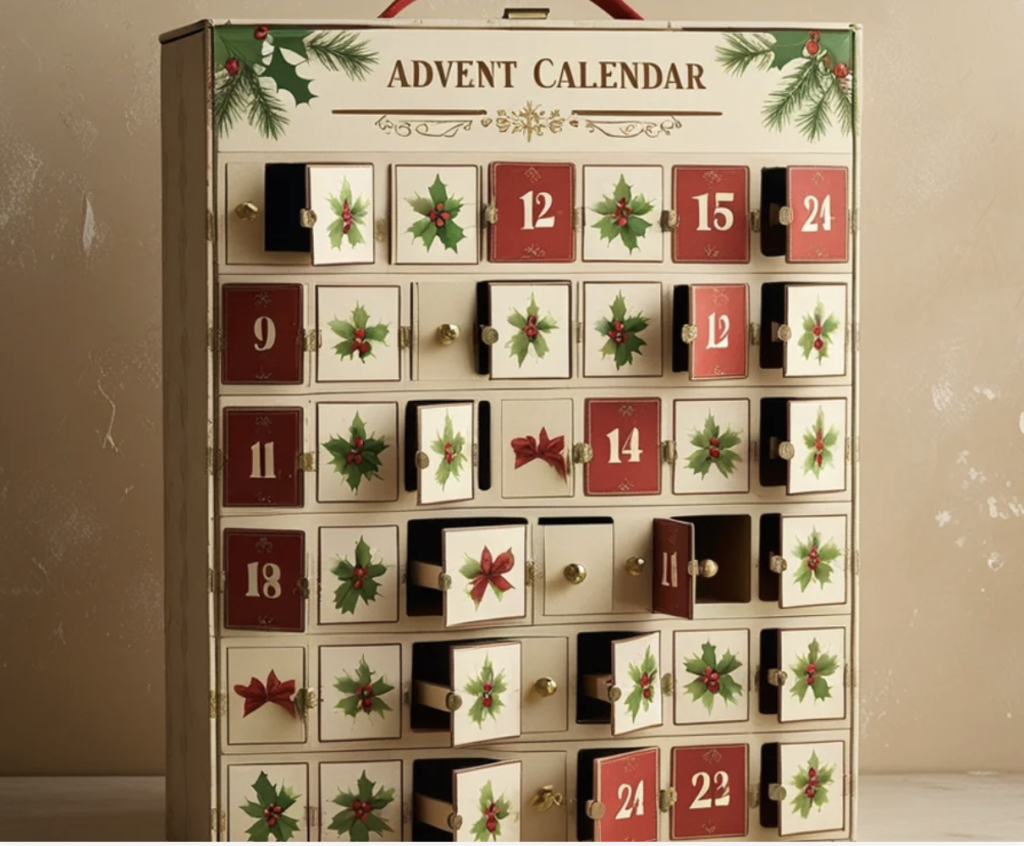
Here’s how it usually goes. Someone says “we should do an advent calendar”, everybody agrees, and three weeks later there’s still no box, no contents list and no budget. Not because it’s hard. It’s because it’s a lot of small things, and nobody knows which one to tackle first. Plenty of good advent calendar ideas never leave the meeting room for exactly that reason, and it’s a shame, because a calendar done well gets talked about all December.
So, a customized advent calendar. Strip away the glitter and it’s a box with 24 little compartments, filled with your products and wrapped in your branding. One door a day, from the first of December. The customer thinks of you for 24 mornings instead of once at checkout, which is a pretty good deal for what’s basically a clever bit of cardboard. Here’s the order I’d tackle things in.
Start with what’s inside
Not the artwork. I know it’s tempting, but contents come first. What you put behind the doors decides the size of every compartment, and that decides the size of the box, the weight, the postage and, in the end, your price. A tea bag and a candle need very different homes. Get all 24 items on a table. Measure the biggest, add a few millimetres of breathing room, write the sizes in a spreadsheet. Dull job, I’ll admit. It also saves a painful back-and-forth with your supplier later. Skip it and you’ll find out at the sample stage, which is the expensive moment to find out.
Think about the mix, too. Twenty-four of the same thing gets old fast (around day six, I reckon). Put smaller bits midweek, nicer ones on weekends, the best behind door 24. Product samples are brilliant for this, because nothing feels pushy when it’s tucked behind a numbered flap. Good seasonal marketing doesn’t announce itself. One more thing: Advent technically begins on a Sunday, which in 2026 is 29 November, but nearly every shop calendar starts on the 1st and that’s what people expect.
Drawers or doors?
Drawers look the best. Little numbered drawers slide out of a sleeve, a bit like a tiny filing cabinet, and the whole thing feels solid on a kitchen bench. They also cost more, because there’s extra cutting and gluing. The sleeve carries a lot of print too, which helps when you want the front to do some of the selling. Drawer-style boxes make sense for skincare, jewellery, anything that deserves to feel like a proper gift box. For a handful of tea bags? Overkill.
Door-style is the budget-friendly cousin. Each day is a perforated flap or a die-cut window with a tray behind it. They ship flat-packed, weigh less, and your freight bill drops, which adds up when you’re posting a few hundred. Then there’s a third route: 24 mini cartons inside one big outer box. I’d pick that for corporate gifting, since each little box can carry its own message.
The heat problem
Most holiday packaging advice you’ll find online was written for cold countries. Ours is a summer Christmas. A courier van in December can easily top 40°C inside, and chocolate starts going soft at about 30. Glue gives up. The thin board sags like a wet biscuit. So ask about thick corrugated cardboard or heavy paperboard for the outer shell, and if anything inside can melt, wrap it in foil or card first.
Kraft paper board suits natural, earthy brands. It prints well enough, though the shade drifts a little from batch to batch, so ask for a swatch. Coated white board gives brighter, cleaner colour if your artwork is detailed. A heavier board feels better in the hand too, and people notice that before they read a word. If most of your buyers are gift shoppers, lean towards the stronger board. Whatever you pick, check it can go in the kerbside recycling bin. Glitter and plastic windows kill that, and buyers do look. Recyclable materials don’t need to be dull.
Getting the box right
Once the structure’s sorted, it turns into real advent calendar boxes, and that’s where cheap suppliers cut corners. Doors that stick. Compartments that won’t close. The numbers printed are a bit crooked. You’ll spot every one of those on a sample and hate finding them on 500 finished units. So ask for a free mockup, or a 3D proof at the very least, before you approve anything. Good suppliers don’t charge for it.
Check tolerances as well. Every item needs a little wiggle room, and a rushed die-line often forgets that. Then do the shake test: pack one sample fully and give it a good rattle. If it rattles in your hand, it’ll rattle in the post. And if the calendar stands up, lean it on a wall for a few weeks, because that’s what customers will do with it. A thicker back panel or a small fold-out stand costs next to nothing. I’d happily pay a few cents more per unit for a sturdier build than refunding a crushed calendar.
Make the numbers big. Seriously. If someone can’t find day 17 in two seconds, the magic’s gone. Use Pantone colour matching so the calendar sits properly next to the rest of your branded packaging, and save full-colour CMYK printing for illustrated designs. A single bold colour on kraft can look more expensive than a busy design, and it may cost less. Not sure about text size? Print one door at actual size on an office printer and hold it at arm’s length.
A custom printed advent calendar also gives you space for the bits people photograph. A short note under each door. A little story that runs across the month. A discount code behind the last number. Add foil stamping to the numerals and matte lamination over the rest and a cardboard box starts to feel like a present. Keep artwork away from folds and door edges, though. Small doors are unforgiving about bleed and safe zones.
Timing and money
Printed packaging is slow, and a calendar is fiddlier than a plain mailer. Artwork sign-off, samples, production, freight: each stage takes longer than you’d hope. If you’re reading this in November, be honest about this festive season. A rush might be possible, but get the delivery date in writing. Lots of brands treat it as a head start and plan next year’s calendar now, which leaves room to test it and open pre-orders.
On budget, price per unit drops as quantity rises. Don’t order a number you only hope to sell, though. Fifty calendars in the garage come January is a bad look. Ask for quotes at two or three quantities and see where the curve flattens. Round numbers feel tidy, but ignore them if the price breaks fall somewhere odd. Count everything: contents, box, inserts, freight. Heavy calendars can swallow a margin quietly. And if you sell to other businesses, a calendar makes a decent option for client gifts, which tends to lift bulk orders with no extra advertising.
The best advent calendar packaging thinks about the unboxing experience too. A welcome card. A line about who made what’s inside. Doors that open cleanly instead of tearing. Those are the details people mention when they post a photo, and a photo is brand storytelling you didn’t pay for. Small touches, but they’re usually what gets remembered after the chocolate is gone.
Where to start
Short version: contents first, then format, then a material that survives the heat, then print. In that order. Packaging Bee AU makes custom packaging for Australian businesses, with free mockups and free shipping across Australia. Send over your product sizes and we’ll work out a quote. A rough sketch is plenty, and the sooner it lands the better.










