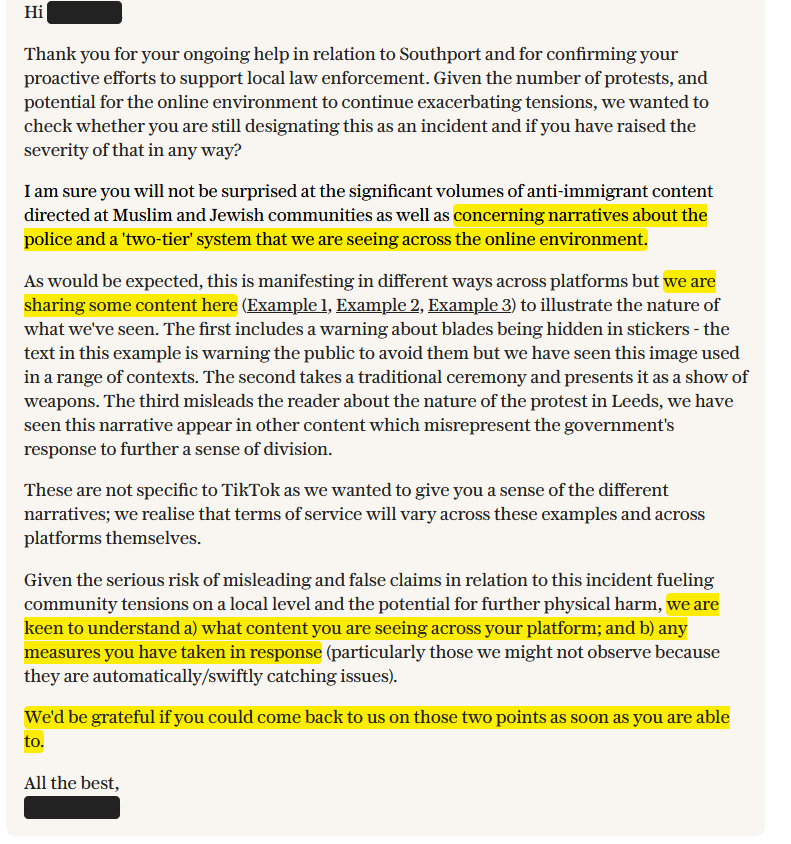
The Telegraph published this headline yesterday: ‘Exposed: Labour’s plot to silence migrant hotel critics.’ The report concerns a team from the ‘National Security and Online Information Team (NSOIT)’, based in the Department of Science, Innovation and Technology. During last summer’s riots, NSOIT was tasked with monitoring ‘concerning narratives’ on social media and flagging them to technology companies such as TikTok for potential removal. Here’s an email they sent.
The irony’s delicious – TikTok, long criticised for links to the Chinese Government, being asked to scrutinise “concerning narratives” by the freedom-of-speech loving British Government?
This story broke in a week when the age verification clause of the Online Safety Act came into force. The Technology Secretary Peter Kyle alleged Nigel Farage’s opposition to the age gate put him on “the same side as Jimmy Saville” (an argument so specious I can’t be arsed to comment further). Kyle, it will be remembered, voted against an official inquiry into the Rape Gang scandal. It was also announced an ‘elite’ police team would be assembled to “monitor anti-migrant social media posts for early signs of unrest”.
In short? The Government seems overly concerned with information management, not border control. Perhaps it’s the logical end point of Blairite media doctrine. A genuine national emergency becomes an issue of perception and optics, not passports and deportations. You imagined that asylum hotel! That Afghan superinjunction? What superinjunction?
Yes, it’s a bloody liberty. But does it, fundamentally, constitute censorship? What’s really going on? Right now, issues around the internet, freedom of speech, public order, extremism and Government overreach are especially salient. For example, here’s a piece I wrote for UnHerd on the subject earlier this week:
My bona fides. I was a police officer for 25 years. I spent eight as a counter-extremism investigator at New Scotland Yard, both in Special Branch and SO15 (the Counter Terrorism Command). Just over a decade ago, I worked for two national units dedicated to online intelligence-gathering. One was an open-source counter-extremism team. The other was the Counter-Terrorism Internet Referral Unit (CTIRU). I am a qualified advanced open-source and Covert Internet Investigator (CII). I have a certificate and everything.
I am, therefore, in a reasonable position to comment. A key theme of my writing is Policing’s post-9/11 surrender of counter-extremism policy to a securocracy comprised of academics, civil servants, activists and quangos. This, sadly, is the end result. The overt politicisation of the discipline into a purely political tool.
The first question I shall answer is simple – do the Government and Police censor social media?
Not exactly.
Would they like to?
Oh yes.
How, then, does it work? Why is the Telegraph’s story important? It demonstrates the influence government gently exercises over private companies, especially overseas – and over whom they have no jurisdiction. Governments exercise far more ‘soft power’ in this respect than police forces. After all, the NSOIT – based at the Department of Science – can influence policy impacting on Facebook, TikTok and X’s UK operations. Nice online platform you’ve got there… shame if something happened to it.
The process is fairly simple. I did this daily on the CTIRU, which was set up to try and remove violent extremism content from the internet. At the start of my shift, I would log on and begin searching for material concerning Islamist terrorism. This was during the early days of the Syrian war, and the appearance of Al-Shabaab in Somalia.
Read More: The Ministry of Truth? The Government, Police and Media Monitoring











