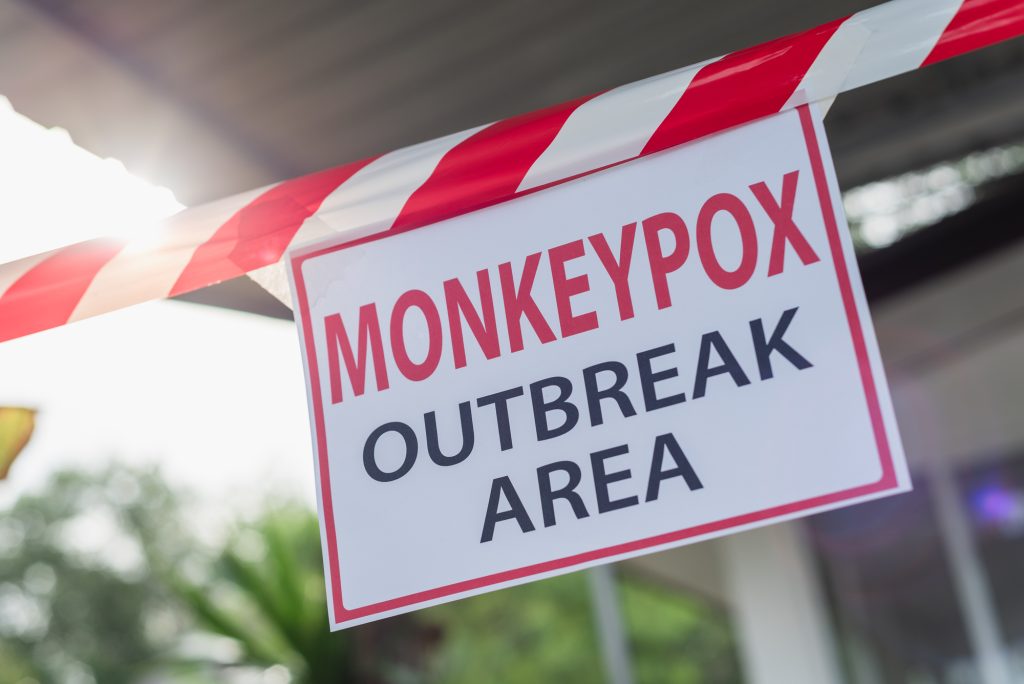
A red and white plastic barrier blocks off an area that has been designated as a monkeypox outbreak zone. A sign on the barrier reads “monkeypox outbreak area”. This image is a reminder of the seriousness of the monkeypox outbreak and the importance of taking precautions to prevent the spread of the virus.
WARS are so inconvenient, especially when they hamper the efforts of the public health lobby to eradicate the latest killer disease. Recently in our favourite source of manufactured anxiety about all things pandemicky, Global Health Now, there was a link to an article in The East African under the heading ‘Conflict in the eastern DRC [Democratic Republic of the Congo] hampers fight against mpox’.
The source of the news report was the XinHua News Agency, the press outlet of the Chinese Communist Party. Where accurate reporting on viruses is concerned, surely nothing can be read into that.
Proving that monkeypox continues to be an epidemiological nonentity, as we have been at pains to point out in these pages for several years, for example here, the report says that this year alone in Africa diagnoses with monkeypox have surpassed 9,959 (so is that 9,960?) and deaths total 85. That puts the infection fatality rate of monkeypox at less than 1 per cent and an infection rate across Sub Saharan Africa (population 1,243,107,741) at 0.000081 per cent.
Even if the figures applied only to the DRC (population 102.3million) the infection rate is 0.0097 per cent. Juxtapose that with the fact that fighting in the Congo has already claimed 700 lives this year.
Of course, death from an infectious virus is no laughing matter and monkeypox looks like a nasty infection to contract. However, in the developed world it is almost totally confined to gay men; in the DRC, where most cases are reported, it disproportionately affects children and pregnant women.
It should also be considered, in relation to figures related to monkeypox from the DRC, that malnutrition is endemic there which puts people at greater risk of succumbing. According to the Global Hunger Index, the DRC scores fifth with Somalia in first place. Pregnant women and children are at most risk of malnutrition in the DRC.
Fit and healthy people experience mild symptoms with little to fear from monkeypox. Even our own NHS, no stranger to whipping us into a frenzy about viral infections as with the recent ‘quad-demic’ which seems to have left most of us standing, says that monkeypox ‘is usually mild and can get better within a few weeks without treatment’.
People in the DRC need food yet the WHO response to monkeypox is to push vaccines which, they say, are ‘at the heart’ of their response. That presumably includes monkeypox vaccines for babies which are being rolled out without clinical trials. After all, what could possibly go wrong?
GAVI, otherwise known as The Vaccine Alliance, are responsible for the distribution of vaccines in the DRC. They get their funding from many sources and they are closely linked to the Bill & Melinda Gates Foundation which recently, along with the European Union, hosted a ‘high level pledging summit’ seeking funding from governments and ‘Billanthropists’ for the work of GAVI. GAVI, which has received over $4.1billion from the Bill & Melinda Gates Foundation provides, along with the Bill & Melinda Gates Foundation, 18 per cent of the funding of the World Health Organization. The Foundation has a permanent seat on the board of GAVI. Clearly, such funding does not come without a few chains attached.
Read More – Monkeypox mania continues to take its toll on common sense










