
A STUDY of millions of citizens shows that covid vaccination ‘significantly increased’ the risks for depression, anxiety, various stress disorders and sleep problems. The same study showed the vaccinations ‘significantly decreased’ the risk for developing bipolar disorder and schizophrenia.
Two South Korean universities randomly selected from the Korean National Health Insurance Service (KNHIS) claims database more than two million (2,154,189) Seoul citizens aged 20 and older who had received two doses of covid vaccines, and 350,983 unvaccinated subjects. Researchers excluded any with a history of schizophrenia, depression, bipolar disorder, anxiety, dissociative, stress related, somatoform (SSD) or psychosomatic disorders (these are mental health conditions where people experience physical symptoms in response to psychological distress), sleep, eating and sexual disorders. This meant excluding almost half a million in the vaccinated group (435,390) and 42,629 in the unvaccinated group. The final number was 1,718,999 vaccinated subjects and 308,354 non-vaccinated subjects.
Post covid infection mental health issues had been studied extensively but not post covid vaccination mental adverse events. This study redressed the balance, and the researchers concluded: ‘Our population-based cohort study provides robust evidence for psychiatric adverse events (AEs) after covid-19 vaccinations. Furthermore, our study provided risks of psychiatric AEs according to vaccine type, revealing that the psychiatric disorders (depression, anxiety, dissociative, stress-related, and somatoform disorders, and sleep disorders) with increased risks due to covid-19 vaccination showed the highest risk in the case of heterogeneous vaccination.’ Heterogenous vaccination means a combination of vaccine types, for example Pfizer combined with AstraZeneca.
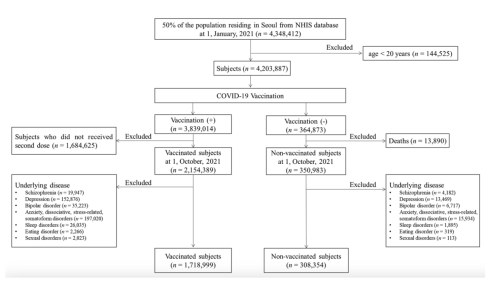
study flowchart
The results were published in the respected journal Nature and produced by scientists from Inje University Sanggye Paik Hospital and Ewha Womans University Hospital. Scientists assessed 10,000 psychiatric adverse events over one and two weeks, then at one month and three months, and concluded that: ‘Covid-19 vaccination increased the risks of depression, anxiety, dissociative, stress-related, and somatoform disorders, and sleep disorders while reducing the incidence and risk of schizophrenia and bipolar disorder.’ It had no effect on sexual disorders or eating disorders, they said.
They added: ‘Our findings suggested that the relationship between covid-19 vaccination and mental illness may be underestimated along with the complexity of its impact on mental health.’
Read More: Major study confirms covid jab harms mental health











