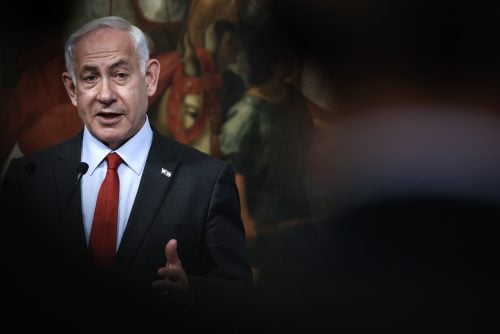
All member states are now obliged to arrest Israel’s prime minister if he arrives on their territory
The International Criminal Court’s arrest warrants for Israel’s Prime Minister Benjamin Netanyahu and his former defence minister Yoav Gallant carry significant legal and political weight.
They have immediate consequences related to the legal obligations of states that are party to the Rome Statute, the treaty that established the court.
All 124 state parties to the Rome Statute are now under an obligation to arrest Netanyahu and Gallant, as well as Hamas military chief Mohammed Deif, who was also issued a warrant despite Israel’s claim that he has been killed in Gaza.
A trial cannot commence in absentia and member states must hand the accused over to the court in The Hague.
But the court does not have enforcement powers. It relies on the cooperation of member states to arrest and surrender suspects.
“State parties have an obligation to cooperate with the court and should do so. This is a critical moment for cooperation with the court.”
Signatories to the statute include all EU member states, as well as the UK.
In the Middle East, they include Jordan, Tunisia and Palestine.
However, other states, notably the US, China, India, and Russia, are not signatories. Most countries in the Middle East and North Africa, including Turkey and Saudi Arabia, also do not recognise the ICC.
On Thursday, following the announcement of Pre-Trial Chamber I, several state parties to the statute announced their intention to uphold the court’s decision.
They include the Netherlands, France, Jordan, Belgium, and Ireland.
When approached by MEE for comment, the UK government refused to say whether it will implement the warrants.
It is likely that Netanyahu and Gallant, who is no longer defence minister, will restrict their travel, as Russian President Vladimir Putin did following the ICC arrest warrant against him.
A future Israeli government may also choose to hand them over to The Hague.
Moreover, states that are not members of the Rome Statute may choose to surrender the suspects to The Hague, bar them from entering their territories, or prosecute them under their domestic jurisdictions.
Triestino Marinello, an international human rights lawyer representing Palestinian victims at the ICC, said it is unlikely Netanyahu will be extradited by Israel while he is in office.
Read More: Netanyahu’s ICC arrest warrant: What to expect next











