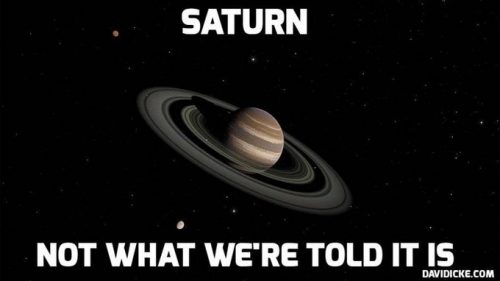
Saturn’s majestic rings will completely disappear from view in just six months and remain invisible for several months after, according to NASA.
The space agency revealed last year that stargazers have until 2025 to view the iconic structures before Saturn tilts edge-on with Earth, turning the vast rings into an almost invisible line.
But an updated forecast has suggested that the rings will become invisible starting on March 23.
The cosmic phenomenon isn’t a sign of disaster, but is due to Saturn’s orbit around the sun and its unique axial tilt should we not jus say an illusion
Come March 2025, Earth and Saturn will align in such a way that stargazers using telescopes will be looking at Saturn’s rings edge-on,
creating the illusion that they have completely vanished.
The rings will gradually come back into view before disappearing again in November 2025.
Astronomers have been observing the rings’ periodic invisibility for centuries, as the event happens every 13 to 16 years.
The last time Saturn’s rings disappeared from Earth’s view was in 2009. This time, they’re forecasted to vanish in March 2025.
That will likely be the last time we’ll be able to see this vanishing act until at least 2027 or 2028, University of Southern Queensland astrophysics professor Jonti Horner wrote in The Conversation.
This rare phenomenon isn’t just a fascinating spectacle for stargazers, but an important learning opportunity for scientists too.
Astronomers have discovered at least 13 of Saturn’s 148 moons during ring plane crossings throughout history, including the famous Titan, Enceladus and Mimas.
During a ring plane crossing in 1966, astronomers caught a glimpse of Saturn’s outermost ring – now known as the ‘E ring’ – for the first time.
This ring isn’t as flat or defined as the planet’s six other rings. NASA describes it as ‘a faint, wispy doughnut encircling Saturn.’
Saturn’s rings appear invisible when Earth crosses through the planet’s ‘ring plane’ – any region of space that’s in line with Saturn’s rings.
From this angle, ‘they reflect very little light and are very difficult to see, making them essentially invisible,’ University of Southern California physicist and astronomer Vahe Peroomian previously told CBS News.
Saturn’s sweeping rings are made of billions of chunks of comets, asteroids and shattered moons that broke up before they reached the planet due to Saturn’s gravity.
As Saturn travels its 29.4-year orbit around the sun, it leans at a 26.7 degree angle and therefore appears to nod up and down as seen from Earth.
When Saturn is tilted away from Earth, we see its rings from below. When the planet is tilted towards Earth, we see its rings from above.
But every 13 to 16 years, Earth and Saturn align in such a way that allows us to view the rings edge-on.
The rings are enormous, stretching about 175,000 miles across and encircling the entire 72,367 mile-wide planet.
But their thickness is less than the length of a football field – which is extremely think compared to the planet itself.
Read More: Saturn’s iconic rings will DISAPPEAR in months, NASA says











