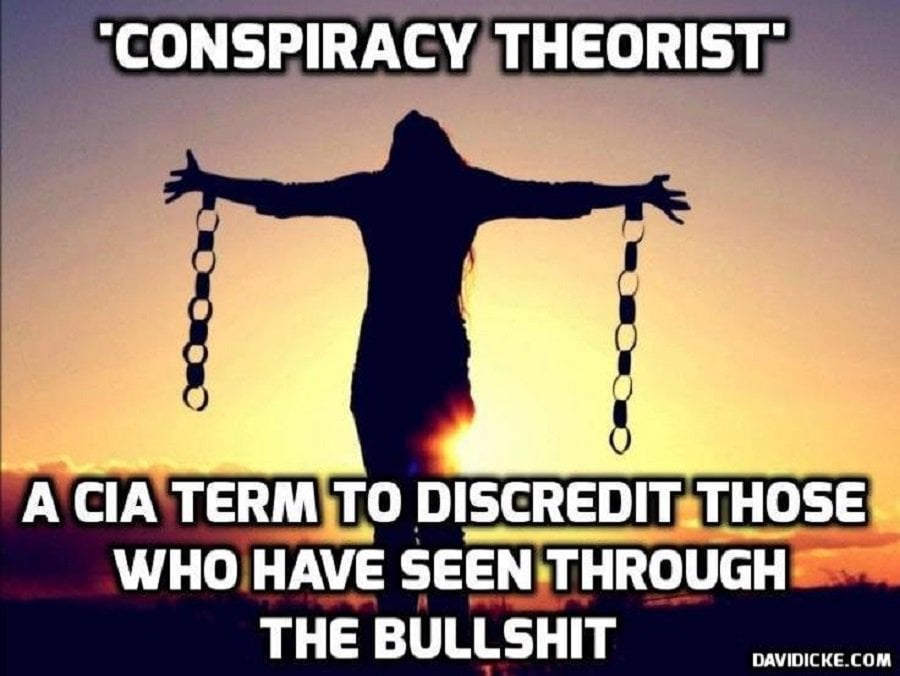
Conspiracy theories. What to some is a sign of critical thinking is, to others, a sign of dangerous insubordination.
I was taught by my father that a good argument can stand up to criticism and that finding someone who disagreed was a fine way to test your theory. I’ve never been too bothered when folks disagree with me. In fact, I’m eager to know why. I want to learn whether or not I’m missing something.
But these days, it seems that I’m in the minority.
The “danger” of conspiracy theories
The term has long been used in a derogatory fashion to belittle the ideas of a person who doesn’t necessarily accept that everything can be taken at face value. These days, it’s used to denote a train of thought that is downright dangerous, even an existential threat to civil society.
What’s everyone so afraid of?
Normies – folks who aren’t big questions of the status quo – used to just shake their heads and smile at the “quirky” conspiracy theorist in their life. They considered it a harmless past-time, an eccentricity.
However, now we have the media breathlessly warning people of the innate deadly danger of conspiracy theories and the people who espouse them. Outright FEAR is being stoked. Let’s take a closer look.
The FBI warning
Back in 2019, the FBI said that conspiracy theories posed a domestic terrorism threat:
“The FBI assesses anti-government, identity based, and fringe political conspiracy theories very likely motivate some domestic extremists, wholly or in part, to commit criminal and sometimes violent activity,” the document said. “The FBI further assesses in some cases these conspiracy theories very likely encourage the targeting of specific people, places, and organizations, thereby increasing the likelihood of violence against these targets.”
The document continued to say that the bureau reached its conclusion “with high confidence” and based on information it obtained from other federal agencies, open source information, court documents, FBI investigations, and human sources.
Yep, this is the same FBI whose own documents concluded that they had investigated the Trump campaign without justification. The one whose director was caught violating DOJ policies and breaking protocol in a lackluster investigation of Hillary Clinton’s emails.
Pardon me if I’m not too worried about what the FBI thinks.
The academic warning
Then we have the people who consider themselves smarter than the rest of us: the academics. The website “The Conversation” boasts that their content “is written by university scholars and researchers with deep expertise in their subjects, sharing their knowledge in their own words.”
So it must be true, right?
Anyway, a postdoctoral research fellow in philosophy warns us of the “dangers” of conspiracy theories. He kindly dumbs it down for the peons by comparing it to “the floor is lava.”
When a child declares that “the floor is lava,” few if any believe the declaration. But that child, and others, begin to act as if the declaration were true. Those who do may clamber onto furniture, and repeat the declaration to others who enter the space. Some children play just for fun, some play to show off their climbing and jumping skills, and some play to appease the child who initiated the game.
Some kids quickly tire of the game and wish to stop playing, but like or respect the child who initiated the game, and don’t want to upset that person by stopping. As the game progresses, some take it too seriously. Furniture is damaged, and some get injured while attempting to leap from one raised surface to another. The lava is fake, but real things get broken.










