
Most of us are aware that MPs and Peers enjoy ‘Parliamentary privilege’: immunity from legal action so that they can speak freely in Westminster. For example, in February 2022, Layla Moran MP used Parliamentary privilege to name 35 people whom she claimed were Russian oligarchs, arguing that they should be sanctioned due to their closeness to Russia’s President during the Ukraine war. In May 2024, David Davis MP used it to highlight an article in a prominent U.S. magazine about the case of the former nurse Lucy Letby. The article could not be reported by the U.K. Media for legal reasons and was not available to U.K. readers – indeed, most people wouldn’t even have been aware of the article until David Davis mentioned it.
Those examples seem to me to be positive uses of Parliamentary privilege: freedom of speech for Parliamentarians, free from the threat of legal action, to bring important matters to the attention of all U.K. citizens.
But I’ve stumbled upon what seems to me an egregious use of Parliamentary privilege. I came across it recently in relation to the Covid Inquiry. It turns out that Parliamentary privilege doesn’t just bestow immunity from legal action but its also precludes what Ministers and MPs say in Parliament being examined, challenged or questioned in public inquiries (which can apportion blame and criticise individuals but absolutely do not constitute legal action). It is spelt out here:
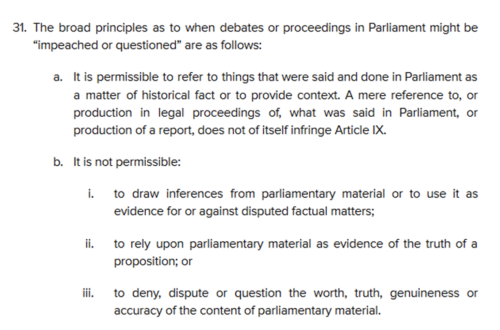
The background is that Perseus Group, of which I am a member, had received a Rule 9 request to submit a written statement to the U.K. Covid Inquiry’s Module 4 (Covid vaccines and therapeutics). Some of our evidence referenced what Ministers had said in Parliament (as recorded in Hansard), in particular that:
- Ministers had ignored or been unaware of similarities between the Covid vaccines and ‘Pandemrix’, the Swine Flu vaccine authorised in 2009. We argued that the rushed trials of both had led to high rates of serious adverse events soon after authorisation. Pandemrix was withdrawn on safety grounds soon afterwards.
- Ministers cited the existence of the COVID-19 Vaccine Benefit/Risk Expert Working Group (EWG) as part of public reassurance about the Covid vaccines but said that EWG minutes are not published. Not that reassuring then. But Ministers were also contradicting what MHRA (for which they are responsible) was saying in FOI replies, namely that MHRA planned to publish the EWG minutes. The minutes still haven’t been published two years later but that’s another story.
- Ministers cited in debates the public health benefit of Covid vaccination but omitted to mention: the low Infection Fatality Rate (IFR) of Covid; the high average age of death; the very high Number Needed to Vaccinate (NNV) in younger age groups; that they knew the vaccine didn’t stop transmission; and that their own evidence showed that Covid infection rates were actually higher in most vaccinated age groups. So much for informed consent – not just for U.K. citizens but also, egregiously, for MPs and Peers whom the Government persuaded to vote for Covid vaccination being a condition of employment in care homes and, very nearly, in the NHS.
Read More: The MPs Hiding Behind Parliamentary Privilege to Make False Vaccine Claims











