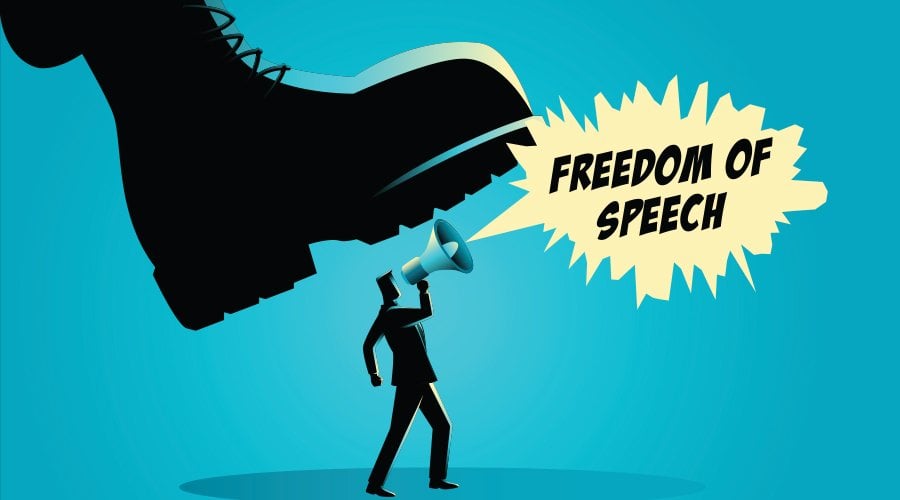
“The First Amendment Is Out of Control.” That headline in a recent column in the New York Times warned Americans of a menace lurking around them and threatening their livelihoods and very lives. That menace is free speech and the media and academia are ramping up attacks on a right that once defined us as a people.
In my new book “The Indispensable Right: Free Speech in an Age of Rage,” I discuss how we are living in the most dangerous anti-free speech period in our history. An alliance of the government, corporations, academia, and media have assembled to create an unprecedented system of censorship, blacklisting, and speech regulation. This movement is expanding and accelerating in its effort to curtail the right that Supreme Court Justice Louis Brandeis once called “indispensable” to our constitutional system.
It is, of course, no easy task to convince a free people to give up a core part of identity and liberty. You have to make them afraid. Very afraid.
The current anti-free speech movement in the United States has its origins in higher education, where faculty have long argued that free speech is harmful. Starting in secondary schools, we have raised a generation of speech phobics who believe that opposing views are triggering and dangerous.
Anti-free speech books have been heralded in the media. University of Michigan Law Professor and MSNBC legal analyst Barbara McQuade has written how dangerous free speech is for the nation. Her book, “Attack from Within,” describes how free speech is what she calls the “Achilles Heel” of America, portraying this right not as the value that defines this nation but the threat that lurks within it.
McQuade and many on the left are working to convince people that “disinformation” is a threat to them and that free speech is the vehicle that makes them vulnerable.
It is a clarion’s call that has been pushed by President Joe Biden who claims that companies refusing to censor citizens are “killing people.” The Biden administration has sought to use disinformation to justify an unprecedented system of censorship.
As I have laid out in testimony before Congress, Jen Easterly, who heads the Cybersecurity and Infrastructure Security Agency, extended her agency’s mandate over “critical infrastructure” to include “our cognitive infrastructure.” The resulting censorship efforts included combating “malinformation” – described as information “based on fact, but used out of context to mislead, harm, or manipulate.” So, you can cite true facts but still be censored for misleading others.
The media has been running an unrelenting line of anti-free speech columns. Recently, the New York Times ran a column by former Biden official and Columbia University law professor Tim Wu describing how the First Amendment was “out of control” in protecting too much speech.
Wu insists that the First Amendment is now “beginning to threaten many of the essential jobs of the state, such as protecting national security and the safety and privacy of its citizens.” He bizarrely claims that the First Amendment “now mostly protects corporate interests.”
So free speech not only threatens your life, your job, and your privacy, but serves corporate masters. Ready to sign your rights away?
Wait, there is more.
There is a movement afoot to rewrite the First Amendment through an amendment. George Washington University Law School Professor Mary Anne Franks believes that the First Amendment is “aggressively individualistic” and needs to be rewritten to “redo” the work of the Framers.
Her new amendment suggestion replaces the clear statement in favor of a convoluted, ambiguous statement of free speech that will be “subject to responsibility for abuses.” It then adds that “all conflicts of such rights shall be resolved in accordance with the principle of equality and dignity of all persons.”
Franks has also dismissed objections to the censorship on social media and insisted that “the Internet model of free speech is little more than cacophony, where the loudest, most provocative, or most unlikeable voice dominates . . . If we want to protect free speech, we should not only resist the attempt to remake college campuses in the image of the Internet but consider the benefits of remaking the Internet in the image of the university.”
Read More: “The First Amendment Is Out Of Control”











