
Authored by Jeffrey Tucker via The Epoch Times
The inflation of the past three years has been devastating for households and businesses running on small margins. It’s all the more frustrating that during those years, we kept being told that it is transitory, softening, calming, cooling, settling down, and essentially not much of a problem anymore. We look back and know now that it was never true.
In reality, three years is a very short time for a major currency to lose at least a quarter of its domestic purchasing power. In the postwar period, it took from the war’s end until 1965 for that to happen. This was also the loss from 1982 to 1992, from 1992 to 2000, and from 2001 to 2012.
That’s hardly a record of stable money, but it is manageable, from the standpoint of accounting and psychology. We were used to it.
What’s happened to the dollar over the past three years is a more extreme loss than anything experienced since the late 1970s. Back then, the dollar lost a quarter of its value between 1975 and 1979, which roughly fits with current experience.
Keep in mind that the current numbers are likely underestimated because they exclude interest rates and completely miscalculate categories such as rent and health insurance (do you believe that health insurance costs less today than in 2018?). Moreover, the inflation index cannot account for the full impact of shrinkflation, quality changes, and hidden fees.
In any case, and even using conventional numbers, the bad news is that the dollar of 1913 has a purchasing power of about 3 cents today.
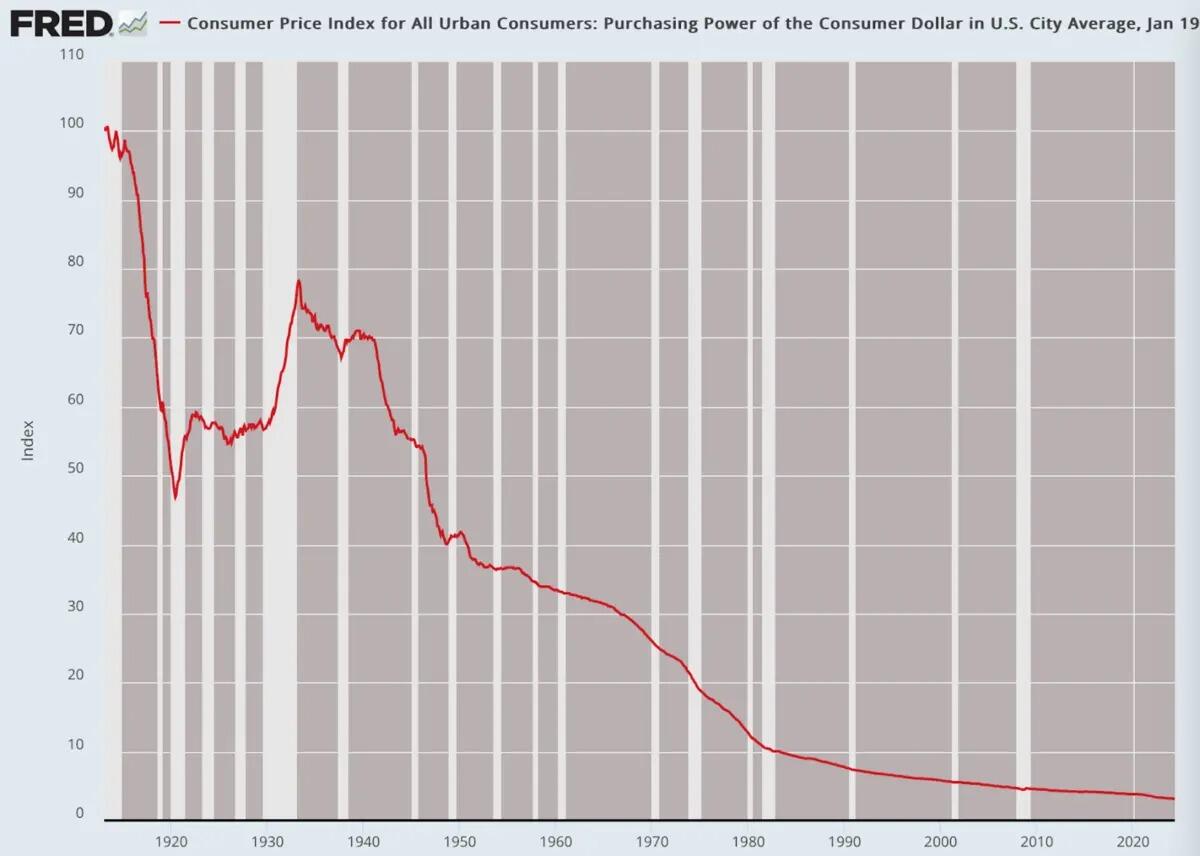
(Data: Federal Reserve Economic Data (FRED), St. Louis Fed; Chart: Jeffrey A. Tucker)
Any purchasing power loss sets in motion a gravitational pull against living standards. It means working harder, scrambling more, adding income to the household revenue stream, and otherwise never quite getting ahead. It also eats into savings by punishing rather than rewarding thrift as should be the case.
But for this to happen in such a short period of time from 2021 to the present is extremely damaging to economic structures. It also damages our understanding of the world around us.
You know this feeling. Not long ago, when you were out shopping, you had a sense if something was a bargain or a rip-off, overpriced or under-priced, something to snap up or leave on the table. Now, everything seems too expensive, but you cannot know for sure.